The Top 5 Smart Farming Tools for Australian Farmers in 2025: The Ultimate Guide | FarmKeeper.au
Target Audience: Broadacre Croppers, Livestock Graziers, Station Managers, and AgTech Adopters
Introduction: The State of Australian AgTech in 2025
Farming in Australia has always been about doing more with less. With the 2025 season bringing new challenges in input costs, labour shortages, and climate variability, the "she'll be right" attitude has evolved into "she'll be right, mate, if we measure it." This year, smart farming isn't just about flashy gadgets; it’s about survival and profitability.
The tools dominating the market are no longer experimental prototypes but rugged, ROI-positive assets that integrate seamlessly into the daily grind of the wheat belt, the cattle station, and the dairy shed. In this comprehensive guide, we explore the Top 5 Smart Farming Tools that are shaping Australian agriculture in 2025, helping farmers make informed decisions. These tools are not just 'cool tech'—they are essential for improving efficiency and resource management. We have selected one 'hero' product from five critical categories: Farm Management Software, Precision Machinery, Aerial Robotics, Livestock Monitoring, and Water Telemetry.
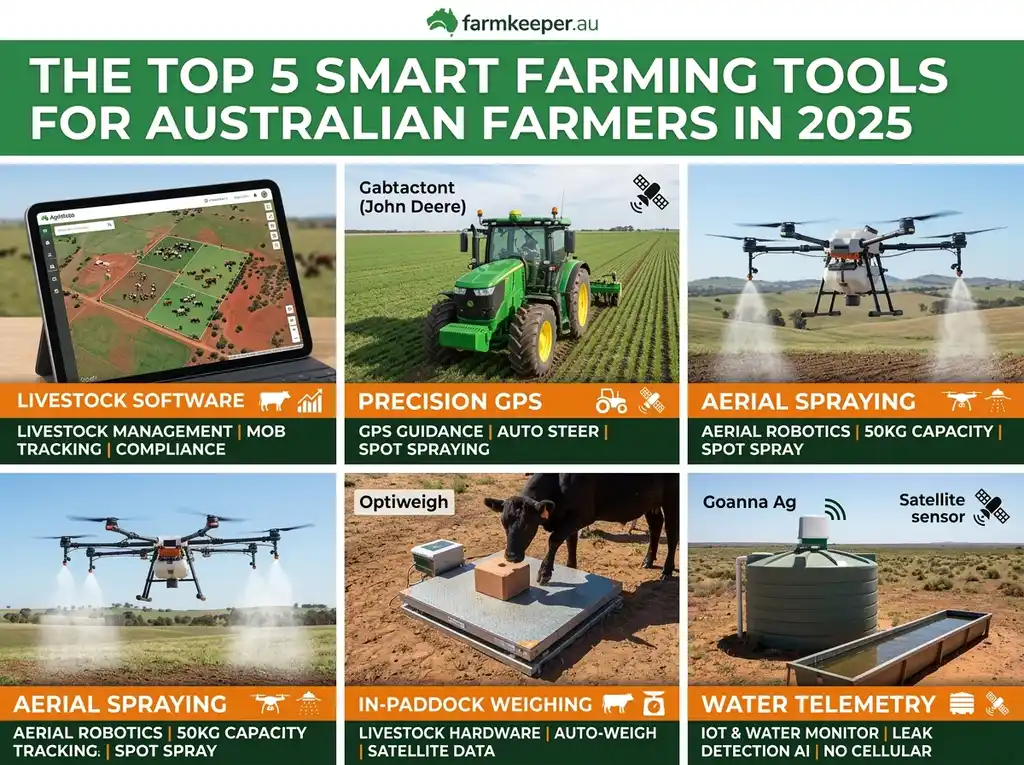
1. The Digital Command Centre: AgriWebb
Category: Farm Management Software (Livestock)
Market Status: Industry Standard, used by over 25% of Australian livestock producers, indicating its widespread acceptance and reliability in 2025.
Why It Is Essential in 2025
Gone are the days of the pocket notebook that goes through the wash. AgriWebb has cemented itself as the operating system for Australian livestock producers. In 2025, with audit compliance and carbon baselining becoming critical for export markets, AgriWebb’s ability to digitise records instantly has made it indispensable.
Deep Dive: Key Features
- Interactive Farm Map: The core of the platform is a digital twin of your property. You don't just see a list of paddocks; you see a satellite map with colour-coded mobs, pasture biomass levels, and withholding periods. Dragging and dropping a mob from one paddock to another on your phone automatically updates stocking rates and feed-on-offer (FOO), saving time and reducing manual errors.
- Grazing Planning & Decision Support: The 2025 updates have introduced advanced predictive grazing. By inputting pasture growth rates, the software calculates "Grazing Days Remaining" for every paddock. This prevents overgrazing before it happens, vital for drought resilience.
- Compliance & Audit Readiness: For producers supplying into programs like MSA (Meat Standards Australia) or EU-accredited supply chains, AgriWebb automates the paper trail. When an auditor arrives, reports on chemical usage, movement history, and treatments are generated in seconds.
- Biosecurity Vault: With FMD (Foot and Mouth Disease) and Lumpy Skin Disease threats looming on the border, the ability to trace every animal’s movement history and contact with other mobs is a massive risk mitigation feature.
Real-World Application: The Station Manager’s Morning
Imagine a station manager in Western Queensland. At 6:00 AM, instead of driving to the yards to check numbers, they open the AgriWebb app. They can see exactly where the contract musterers moved the weaners yesterday. They notice a "Withholding Period" warning on Paddock 4 because it was sprayed for woody weeds last week—a potential disaster averted because the app flagged it before they moved cattle in.
The ROI Case
- Time Savings: Users report saving an average of 5–10 hours per week on record-keeping.
- Productivity: By optimising stocking rates and avoiding under-grazing or over-grazing, producers typically see a 5–10% increase in biomass utilisation.
- Cost: Subscription models vary based on farm size, but for a standard 2,000-head operation, the cost is often recovered within the first month through prevented animal loss or improved feed budgeting alone.
2. The Autonomous Workhorse: John Deere Precision Ag Ecosystem
Category: Precision Agriculture & Autonomy
Focus Product: StarFire™ 7500 Receiver & G5Plus Command Center
Market Status: Dominant Leader in Broadacre
Why It Is Essential in 2025
In 2025, "precision" is no longer enough; farmers demand "autonomy." John Deere’s ecosystem has evolved from simple auto-steer to full-blown process automation. The adoption of the StarFire™ 7500 receiver has exploded in the WA wheat belt and NSW cropping regions because of its resistance to signal shading and its "RTK-like" accuracy without needing a local base station.
Deep Dive: Key Features
- SF-RTK Signal: The 7500 receiver offers 2.5 cm pass-to-pass accuracy with a pull-in time (time to get signal) that is 73% faster than the previous generation. This means you turn the key and go—no waiting 20 minutes for satellites to align while the seeder sits idle.
- AutoTrac™ Turn Automation: It’s not just about driving straight lines anymore. The system now manages the entire headland turn—slowing the tractor, raising the planter, turning the wheels, engaging the hydraulics, and lowering the planter back down for the next pass. This reduces operator fatigue significantly during 16-hour shifts.
- See & Spray™ Technology: While premium, this is the feature of the year. Cameras on the boom detect green weeds on fallow ground and trigger nozzles individually. Australian trials have shown herbicide savings of up to 77% by spraying only weeds, not bare dirt.
- Operations Centre: The cloud platform connects the machine to the office. An agronomist in Perth can upload a prescription map for variable rate lime spreading directly to a tractor in Esperance. The driver doesn't touch a USB stick; they accept the file on the screen and drive.
Real-World Application: The Harvest Window
During a tight harvest window in the Mallee, a contractor is running two X9 combines. Using Machine Sync, the combines talk to the chaser bin tractor. As the chaser bin approaches, the combine takes control of the tractor’s steering and speed, locking it under the auger for a spill-free unload while moving at 10 km/h. This eliminates the risk of collision and grain loss, allowing even inexperienced drivers to operate the chaser bin effectively.
The ROI Case
- Input Costs: Variable Rate Application (VRA) enabled by this tech typically reduces fertiliser and chemical bills by 15–20%.
- Overlap Reduction: On a 5,000-hectare program, reducing overlap by just 2% (standard with AutoTrac) saves 100 hectares worth of seed, fuel, and chemicals. That is tens of thousands of dollars annually.
3. The Aerial Applicator: DJI Agras T50
Category: Drones & Robotics
Market Status: High Growth (Rapidly replacing ground rigs for spot spraying)
Why It Is Essential in 2025
The DJI Agras T50 has broken the barrier between "toy" and "tool." In 2025, wet years and inaccessible terrain have made ground rigs useless in many parts of the East Coast. The T50 is the solution, capable of carrying 40kg of liquid or 50kg of granules, making it a legitimate piece of farm machinery.
Deep Dive: Key Features
- Dual Atomising Spray System: The T50 uses magnetic drive impeller pumps and dual atomisers. This produces an incredibly uniform droplet size that can be adjusted on the fly via the remote. For Australian farmers fighting herbicide-resistant weeds, droplet control is essential to prevent drift while ensuring kill.
- Phased Array Radar: The T50 can see wires, poles, and dead trees in 360 degrees, day or night. It features "Terrain Follow", which allows it to maintain a constant height over complex, undulating gullies in the Great Dividing Range—areas where a tractor would roll over.
- Fast Charging: The new DB1560 batteries charge in 9 minutes using the fast charger. With just three batteries, a pilot can fly continuously all day without downtime.
- Spreading System: It takes less than 3 minutes to swap from a spray tank to a spreading tank. This is widely used for spreading mouse bait, slug pellets, or overseeding clover into wet pastures.
Real-World Application: BlackBerry Control
A grazier in the Victorian High Country has 200 hectares of steep, rocky gullies infested with blackberries. Traditionally, this would require a helicopter (expensive) or hand spraying (dangerous and slow). Using a T50, the farmer maps the boundary and sets the drone to fly autonomously. The drone navigates the steep slopes and applies the chemicals precisely. The job that took weeks by hand is done in two days, with zero risk of a quad bike rollover.
The ROI Case
- Contractor vs. Owner: A T50 kit costs roughly $37,000–$40,000 AUD. Aerial application contractors charge $25–$40 per hectare. If a farmer sprays over 1,000 hectares a year (including multiple passes), the drone pays for itself in Year 1.
- Soil Compaction: Zero soil compaction compared to a heavy self-propelled sprayer, which preserves yield potential in wet paddocks.
4. The Silent Observer: Optiweigh
Category: Livestock Hardware
Market Status: High Adoption in the Beef Sector
Why It Is Essential in 2025
Weighing cattle traditionally involves mustering, yarding, and stress, which can lead to weight loss (shrinkage). Optiweigh has revolutionised this by bringing the scales to the paddock. In 2025, with cattle prices normalising, every kilogram of gain counts.
Deep Dive: Key Features
- In-Paddock Autonomy: The unit is a portable weighing platform that lures cattle with a molasses lick block or mineral attractant. As the animal steps onto the lick block, the unit reads their EID (electronic tag) and records their weight.
- No Stress, No Shrink: Because the animal is not mustered or confined, there is no "curfew" weight loss. The data reflect the animal's accurate paddock weight.
- Satellite Connectivity: It sends data to the cloud via satellite, meaning it works in the most remote paddocks of the Northern Territory or the Pilbara where there is no 4G.
- The Dashboard: The farmer gets a daily email or app notification showing the "Average Daily Gain" (ADG) of the mob. If ADG drops, it’s an early warning signal that feed quality is declining or the animals have worms, often weeks before it would be visually apparent.
Real-World Application: Hitting the Grid
A beef producer targeting the Coles or Woolworths domestic grid needs steers between 300kg and 320kg dressed weight. If they send them too light or too heavy, they get penalised. Using Optiweigh, the producer watches the mob's average weight climb daily. They can book the truck for the exact day the mob hits the target weight, maximising the price per head and eliminating the guesswork of "eyeballing" them.
The ROI Case
- Labour Savings: Eliminates 3–4 musters per year dedicated solely to weighing.
- Feed Efficiency: By detecting a drop in weight gain early, a farmer can supplement feed immediately.
- Optiweigh claims an ROI of 13% on labour costs recovered in the first year, but it's significantly higher when factoring in improved market timing. For a mob of 400 steers, avoiding a grid penalty on just 10 animals pays for the unit.
5. The Water Watchdog: Goanna Ag (GoTank & GoSense)
Category: IoT & Water Monitoring
Market Status: Widespread in Remote Areas
Why It Is Essential in 2025
Water is the most critical resource on an Australian farm. The classic "water run"—driving hundreds of kilometres a week to check if troughs are full—is the most significant waste of fuel and labour on a station. Goanna Ag’s satellite-connected sensors have become the gold standard for reliability in 2025.
Deep Dive: Key Features
- GoTank: A simple, rugged sensor that drills into the top of a poly tank or concrete header. It uses a radar or hydrostatic pressure sensor to measure water levels.
- Direct-to-Satellite: Unlike older systems that required a confusing network of LoRaWAN gateways and antennas on hills, the new Goanna units often connect directly to low-earth orbit satellites. They work everywhere.
- Leak Detection AI: The software learns the normal "heartbeat" of the tank—water goes down during the day (stock drinking) and up at night (pumping). If the water level drops at 2:00 AM, the system knows it’s a leak (e.g., a blown pipe) and sends a "Critical Alert" SMS immediately.
- GoRain: Often paired with tank sensors, these automated rain gauges allow a farmer to see precisely which paddock got the storm, helping them decide where to move stock for green pick.
Real-World Application: The Summer Heatwave
It is January, 42°C. A pipe fitting blows on a remote trough 40km from the homestead. Without a sensor, the stock might go without water for 2-3 days until the next water run, leading to death or severe welfare issues. With Goanna Ag, the farmer gets an alert at 4:00 AM: “Tank 4 Rapid Level Drop.” They drive straight there, fix the pipe, and save the mob. The system transforms a potential catastrophe into a minor maintenance job.
The ROI Case
- Vehicle Wear & Labour: A PIRSA (SA Government) case study showed an ROI of 197% in the first year. For a property that spends $10,000/year on diesel and labour for water runs, cutting that by 50% saves $5,000 instantly.
- Asset Protection: The value of saving a single prize bull or a small mob of sheep from dehydration covers the cost of the entire network setup.
Summary Table: Quick Comparison
| Tool | Best For | Primary Benefit | Approx. Cost (AUD) |
|---|---|---|---|
| AgriWebb | Livestock Management | Audit compliance & productivity insights | Subscription (varies by head count) |
| John Deere StarFire | Broadacre Cropping | 2.5cm accuracy & reduced overlap | ~$5k - $10k hardware + license |
| DJI Agras T50 | Spraying/Spreading | Accessing wet/steep terrain | ~$38k - $45k (Full Kit) |
| Optiweigh | Beef Production | Accurate weight gain w/o mustering | ~$15k - $20k unit purchase |
| Goanna Ag | Water Security | Eliminating manual water runs | ~$1,200 setup + annual data fee |
AgriWebb and FarMIQ Alternatives: Choosing the Right Farm Software
As farm management software shifts to cloud-only models, many Australian livestock producers are searching for MSA-compliant AgriWebb alternatives or comparing AgriWebb vs FarMIQ. While cloud portals offer excellent map-based pasture records, they have two primary limitations: high recurring monthly subscription fees and complete dependence on internet connections.
If you operate in remote blackspots or want to avoid ongoing monthly data fees, look for software that features offline caching or pair your software with point-to-point telemetry hardware. This allows you to log herd treatments, pasture biomass, and stock weights locally on your phone in the paddock, syncing to the cloud only when you return to the homestead.
Cloud Farmer and AgCommander Alternatives: Going Subscription-Free
For broadacre croppers and mixed farmers, tools like Cloud Farmer and AgCommander are well-known. However, rising monthly SIM card fees and subscription packages have farmers seeking a cost-effective Cloud Farmer alternative or AgCommander competitor. When every gate sensor, rain gauge, and pump switch requires an individual cellular SIM card, annual subscription fees quickly add up to thousands of dollars.
A subscription-free alternative is to set up a private, point-to-point LoRa network. By owning the infrastructure, you bypass cellular providers entirely, transmitting tank levels, gate alarms, and solar voltage data across 20km directly to your home base with zero ongoing costs.
Bonus: The Off-Grid Watchdog – Keeper v3.0 (by Farmkeeper)
Category: Remote Monitoring & Automation Hardware
Market Status: The "Subscription-Free" Alternative (Best for Remote Assets & Security)
Why It Is Essential in 2025
While major platforms manage your digital yield data, the Farmkeeper Keeper v3.0 manages your physical farm assets. In 2025, Australian farmers are experiencing subscription fatigue—paying monthly fees for every single sensor—and struggling with cellular coverage blackspots. The Keeper v3.0 is built specifically for remote Australian conditions. It bypasses the cellular network entirely, creating a private, secure radio link that reaches up to 20km line-of-sight. It is the ideal subscription-free alternative to cellular monitoring for sheds, gates, and tanks.
Deep Dive: Key Features
- 20km Line-of-Sight Range: Operating on the 915 MHz frequency (LoRa technology), the Keeper communicates directly with a Monitoring Display console at your homestead. It requires no internet, no SIM cards, and no ongoing monthly data fees.
- Battery-Free Supercapacitor Power: Unlike telemetry systems that use fire-prone lithium batteries that fail in the outback summer, the Keeper v3.0 uses an internal supercapacitor. It is powered by 6-30V DC (solar or vehicle battery), and the supercapacitor provides backup power to transmit immediate alerts if wires are cut or power is lost.
- 8 Adaptable Modes: Change operating modes with a simple button press. Configurable options allow you to monitor PIR motion sensors (shed security), gate switches (property borders), and float levels (water telemetry).
- High-Current Output Control: Features two 50A low-side switches, allowing you to remotely trigger heavy loads like sirens, strobe lights, or pump relays directly from your home console.
Real-World Application: The Off-Grid Shed Watchdog
Consider a machinery shed and diesel fuel tank located 15km from the homestead in a cellular dead zone:
- The Problem: The area is vulnerable to fuel theft, and checking tank levels manually wastes an hour of travel time daily.
- The Farmkeeper Solution: The farmer installs a Keeper v3.0 powered by a small solar kit, connecting a magnetic reed switch to the shed door and a float switch to the fuel tank.
- The Result: If the shed door is opened at 2:00 AM, the Monitoring Display on the farmer's bedside table buzzes immediately. The display shows the specific alarm type, and the farmer can remotely activate a warning siren at the shed to deter the intruder—without any internet or mobile phone service.
The ROI Case
- No SIM Fees: Bypassing cellular networks saves $15–$35/month per sensor, meaning the hardware pays for itself within months.
- Scale Safely: A single Monitoring Display can manage up to 12 remote Keeper units, allowing you to protect multiple gates, pumps, and sheds under a single home base console.
- Anti-Tamper Design: The backup supercapacitor ensures that if an intruder cuts the power line, the Keeper stays alive long enough to transmit a tamper alert to the homestead.
Conclusion: Building the Hybrid Farm of 2025
In 2025, the "smart farm" isn't just about having the most expensive machinery or the most complex software. It is about reliability. As we’ve seen, the industry giants like John Deere and AgriWebb are pushing the boundaries of what’s possible with automation and big data. They handle the heavy lifting of compliance and broadacre efficiency.
But as every Australian farmer knows, the farm doesn't end where the 4G signal drops out. This is where tools like the Keeper v3.0 are carving out a vital niche. While the big platforms manage your yield maps and audit trails, rugged, subscription-free hardware is needed to watch over the physical reality of the "back block"—the silent pumps, the remote sheds, and the distant troughs that cloud software can't reach.
The most successful operations this year will be those that adopt a hybrid approach: leveraging the cloud for decision-making while relying on independent, off-grid hardware for security and asset control. Whether you are saving fuel with a DJI drone, saving a muster with Optiweigh, or securing your perimeter with Keeper, the goal remains the same: doing more with less, and sleeping better at night knowing the farm is watching itself.