Control Solar Station: Monitor Voltage, Temperature & Access Remotely | FarmKeeper.au
Protect your expensive off-grid power assets from extreme heat, theft, and failure.
There are few things more frustrating than driving an hour out to a remote bore pump or communications relay, only to discover that the solar station powering it has completely failed. Whether the deep-cycle batteries have been cooked by the harsh Australian sun or a critical voltage drop has tripped the inverter, the result is the same: wasted time, lost productivity, and expensive repairs.
The Vulnerability of Off-Grid Power in the Outback
Solar power has revolutionised Australian farming, allowing us to put pumps, sensors, and telemetry exactly where they are needed without running kilometres of costly trenching and mains power. However, a remote solar station is heavily exposed to the elements. Extreme heat accelerates battery degradation, while cloudy weeks can drain your reserves past the point of no return. Furthermore, isolated infrastructure is a prime target for theft or tampering.
To truly rely on this infrastructure, you must be able to control your solar station without physically being there. Most farmers assume this requires complex cellular data plans, which are useless if the station sits in a mobile black spot. But with the right hardware, achieving complete oversight and control is entirely possible off-grid.
Monitoring Voltage Level and Battery Temperature
Batteries are the most expensive component of any solar station, and heat is their worst enemy. In an enclosed metal cabinet during summer, ambient temperatures can easily exceed 50°C, drastically shortening the lifespan of lead-acid or lithium battery banks.
By constantly monitoring voltage level and battery temperature, you gain a critical early warning system. You can see exactly when a battery bank is struggling to hold a charge, or when the internal cabinet temperature reaches a dangerous threshold, allowing you to intervene before thousands of dollars of equipment are ruined.
Securing Access to the Station
Vandalism and theft are unfortunate realities in rural areas. Having real-time alerts regarding access to the station ensures you are immediately notified if a cabinet door is pried open or left ajar by a contractor. Knowing exactly when someone interacts with your critical power infrastructure provides unparalleled peace of mind.
Enter Keeper v3.0: Shut Down or Start Systems Remotely
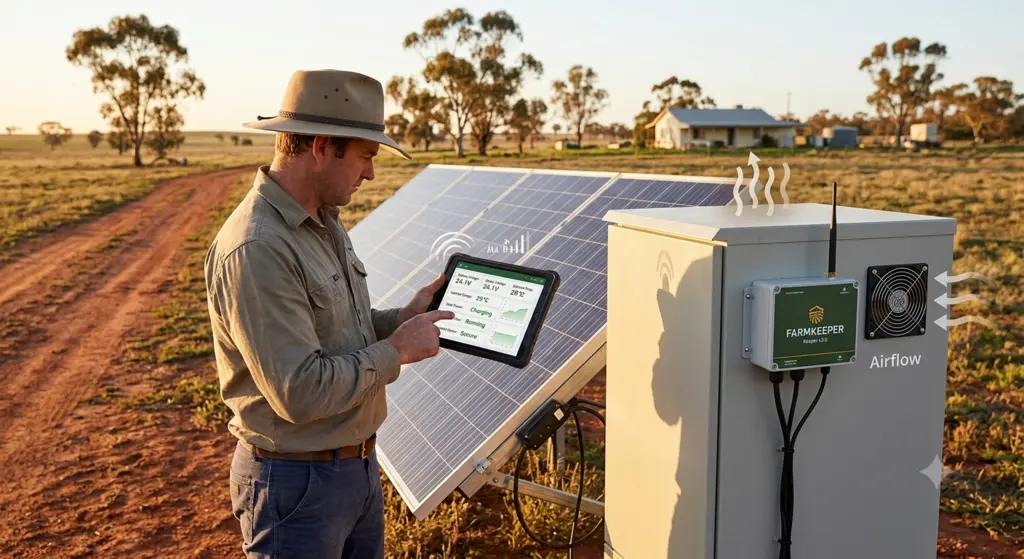
The FarmKeeper Keeper v3.0 is built exactly for these high-stakes, off-grid environments. Utilising the license-free 915 MHz LoRa band, it bypasses the mobile network entirely, delivering a massive 20 km line-of-sight range back to your homestead—with absolutely zero subscription fees.
Here is how the Keeper v3.0 allows you to fully control and protect your solar station:
- Built-in Voltage Monitoring: The Keeper v3.0 naturally operates on a wide 6V to 30V DC input. It automatically monitors its own supply voltage and transmits this data back to your central Monitoring Display.
- Manage Cooling Conditions: You can wire a digital temperature/humidity sensor (like a DHT22) directly into Terminals 5, 6, and 7. If the temperature spikes, you can use the Keeper’s 50A high-current outputs to remotely engage 12V exhaust fans, instantly managing the cooling condition inside the battery box.
- Instant Security Alerts: Wire a simple magnetic reed switch to the Door Sensor Input (Terminal 8). If the cabinet is opened, an instant alarm is triggered on your home display.
- Remote System Reboot: Sometimes, solar inverters or charge controllers just need a hard reset. Instead of driving out to flip a switch, you can wire the Keeper's External Device Output to a high-power relay. With the push of a button from your kitchen, you can shut down or start the system remotely.
How to Wire Your Solar Station Management System
Setting up the Keeper v3.0 to protect your solar setup is a straightforward process:
- Power & Voltage: Connect the main battery bank to Terminal 1 (+) and Terminal 2 (-). The system will now begin tracking real-time voltage.
- Temperature Sensor: Connect a DHT22 or DS18B20 digital sensor to the dedicated temperature terminals to monitor the battery cabinet climate.
- Security: Wire a normally-closed door contact switch to Terminal 8 and Terminal 9 (Ground).
- Cooling / Shut Down Relay: Run the negative wire of a heavy-duty relay coil to Terminal 3 (Output 1). When triggered from your remote display, this relay can either switch on cooling fans or interrupt power to reboot the main system.
A failed solar station can grind your operations to a halt. By installing an autonomous, subscription-free communication system, you can extend the life of your batteries, prevent theft, and resolve technical faults from the comfort of your living room.
Ready to take control of your off-grid power?
Read through our technical documentation to see how easily it integrates, or get in touch to discuss securing your specific solar setup.