Meet Keeper v3: Australian Off-Grid Security Guide | FarmKeeper.au
Introduction: The Tyranny of Distance
In Australia, distance is the enemy. It eats fuel, it eats time, and it hides problems until they become disasters. For decades, the only way to know if a water tank was leaking at the back boundary was to drive there. The only way to tell if a shed door had blown open in a storm was to see it with your own eyes.
The "AgTech" boom promised to fix this. Still, it often brought a new set of problems: expensive monthly subscriptions, reliable 4G signals that don't exist in the bush, and delicate hardware that melts in the Pilbara heat.
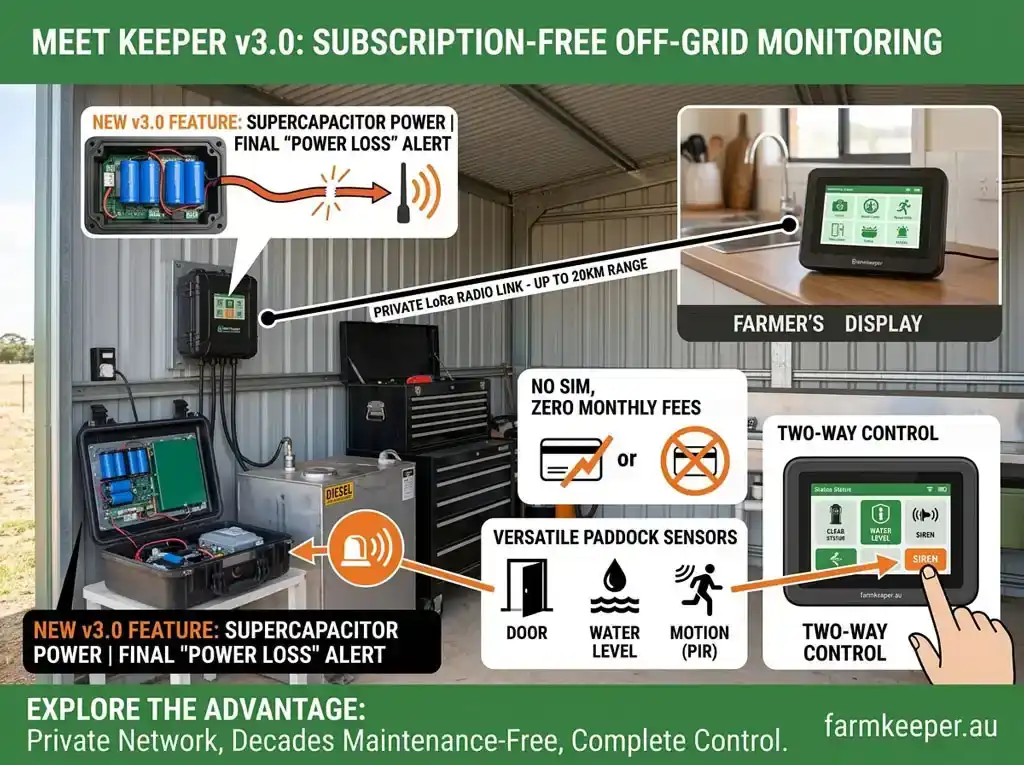
Enter Keeper v3.0, a security system built for off-grid Australian farms, operating independently without SIM cards or monthly fees. Designed specifically for the harsh realities of the Australian landscape, the Keeper v3.0 is an autonomous security and remote monitoring system that operates off-grid, without SIM cards or monthly fees. It uses the license-free 915 MHz ISM band to transmit critical data over 20 kilometres line-of-sight.
This article is a comprehensive introduction to the system. We will tear down the hardware, explain the unique "supercapacitor" safety technology, and walk you through exactly how to deploy a farm-wide nervous system that watches your assets so you don't have to.
Chapter 1: The Philosophy of Keeper v3.0
The Keeper v3.0 was built to solve a specific equation: Reliability vs. Complexity. Most modern IoT (Internet of Things) devices are "cloud-first." They rely on a chain of dependencies: the device needs WiFi, the WiFi needs a router, the router needs the NBN, and the NBN needs power. If one link breaks, the system fails.
The Keeper v3.0 is "field-first." It consists of two main components:
- The Control and Management Unit: The rugged device you install at the remote site (the paddock, the shed, the dam).
- The Monitoring Display: The portable unit that sits on your kitchen bench or office desk.
They talk directly to each other. There is no intermediary. There is no server in Silicon Valley deciding if you are allowed to see your water levels today.
The "No Subscription" Promise
Because the system uses LoRa (Long Range) technology on the 915 MHz band, you own the network. Once you buy the hardware, the running cost is zero. This is a critical shift for Australian farmers suffering from "subscription fatigue," where every soil probe and weather station demands a monthly ransom.
Chapter 2: Hardware Deep Dive – The Control Unit
The heart of the system is the Control and Management Unit. Let's look under the hood at the engineering decisions that make this unit survive in the bush.
Power Flexibility (6V to 30V DC)
It accepts a broad input range of 6V to 30V DC, allowing you to power it with various existing batteries or solar setups.
- Have an old 12V car battery? That works.
- Have a 24V solar setup for a pump? That works.
- Have a 6V lantern battery? That works too.
The efficiency is remarkable. In its normal monitoring state, the device draws just 7 mA. Even when transmitting a powerful radio signal across the property, it only peaks at 40 mA. This means a small solar panel and a standard battery can keep this unit running indefinitely.
The Supercapacitor Advantage
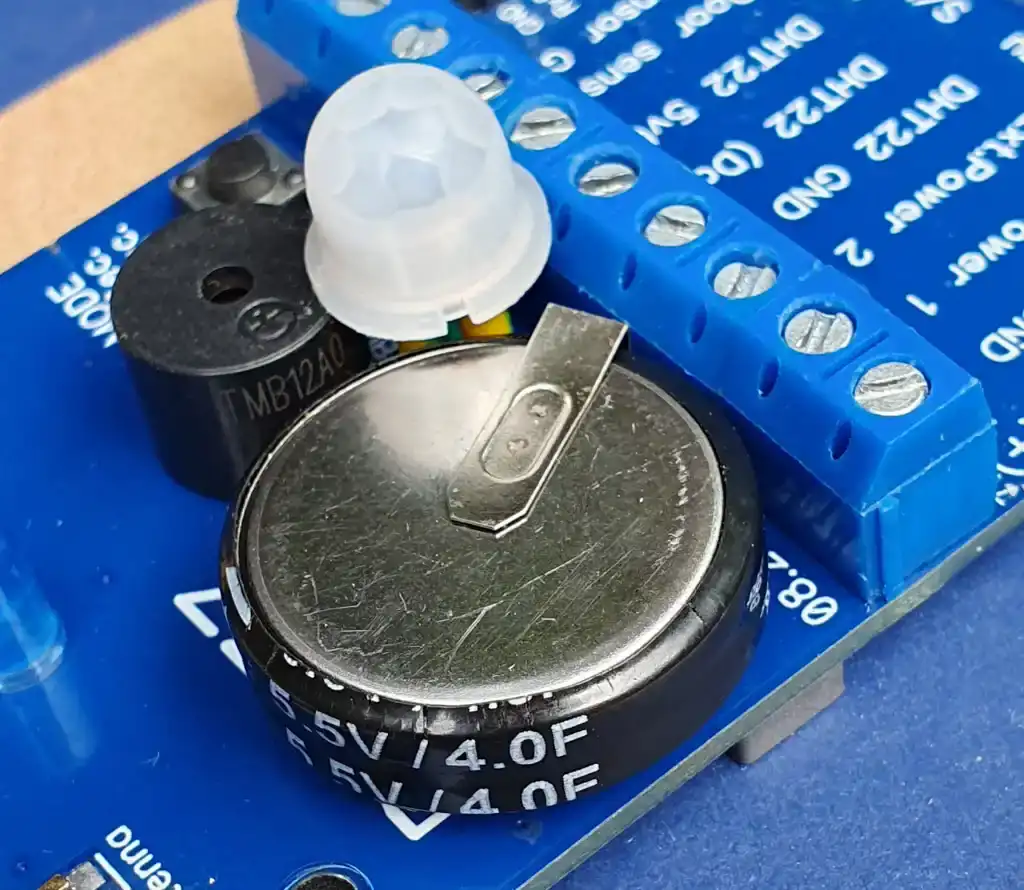
Super capacitor
This is the standout feature of the Keeper v3.0. Most security devices rely on internal lithium batteries for backup. The problem? Lithium batteries hate Australian heat. Please leave them in a metal shed in 45°C summer, and they degrade, swell, or catch fire.
The Keeper v3.0 replaces traditional batteries with an internal supercapacitor, offering decades of maintenance-free, fire-safe backup power.
- Maintenance Free: Unlike a battery that needs replacing every 2 years, a supercapacitor lasts for decades.
- Safety: It is not prone to fire hazards.
- The "Death Gasp": If a thief cuts the power cables to your shed, the supercapacitor holds enough charge to keep the system alive for a few minutes. This allows the Keeper to send a final "Critical Alarm" to the house, notifying you of the power cut before it shuts down.
The Sensor Suite
The board is equipped with versatile inputs to monitor the physical world:
- PIR Motion Sensor (Built-in): A Passive Infrared sensor is integrated directly into the unit (Component 13). It detects movement of people or animals up to 5 metres away.
- Door Sensor Input: A dedicated input (Terminal 8) for magnetic reed switches. It detects contact closure instantly.
- Water Sensor Input: A specialised input (Terminal 10) designed with "inertia". It has a built-in 20-second delay. This is a brilliant feature for troughs—it prevents false alarms caused by wind or stock drinking ripples. The sensor must be wet (or dry) for a full 20 seconds before the alarm triggers.
- Temperature/Humidity: Dedicated terminals (5, 6, 7) allow you to wire in digital sensors like the DHT22 or DS18B20.
High-Power Control Outputs
The Keeper isn't just a passive observer; it can take action. It features two External Device Outputs (Terminals 3 and 4). These are "low-side switches" capable of handling up to 30V and a massive 50A starting current.
Why 50 Amps? Electric motors (like pumps) draw a massive spike of current when they first start up (inrush current). Most standard electronics would fry. The Keeper v3.0 is built to handle this, allowing you to wire a pump relay or a high-powered spotlight directly to the unit.
Chapter 3: The Communications Backbone (LoRa 915 MHz)
How do we get a signal 20km away without a SIM card? The answer lies in physics. The Keeper v3.0 operates on the 915 MHz ISM band 21. This is a low-frequency band that offers excellent penetration through obstacles like foliage and timber, which typically block higher frequency signals like WiFi (2.4 GHz).
Range Capabilities
- Open Area: The manual specifies a reliable range of at least 20 kilometres in open areas.
- Obstructions: While metal structures and concrete can reduce signal strength, the system is designed to punch through typical rural environments.
- Line of Sight: The 915 MHz signal behaves like light—it travels best when the sender can "see" the receiver. Hills and earth are the enemy. Placing the unit higher significantly increases the coverage area.
The Antenna Factor
The unit comes with a standard SMA connector (Component 12). This is a pro-grade feature. It means if you are monitoring a shed inside a metal hangar (a Faraday cage), you can unscrew the standard antenna, attach a coaxial cable, and mount a high-gain external antenna on the roof. As long as the antenna is tuned for 915 MHz, you can boost your range drastically.
Chapter 4: The Monitoring Display – Your Command Centre
The Monitoring Display is where the data lands. It is a portable unit that looks a bit like a weather station but acts like a security console.
Multi-Site Management
One display can track and manage up to 12 separate Control Units. This allows you to sectorise your farm:
- Unit 1: Diesel Tank
- Unit 2: Workshop
- Unit 3: Shearing Shed
- Unit 4: Ram Paddock Trough
You can cycle through each unit using the front panel buttons. The display stores the individual configuration for each remote unit in its non-volatile memory, meaning it remembers your settings even if the power goes out.
Flexible Power
The display is designed for 24/7 operation via a USB power cable (Component 6). However, it also has a compartment for 3 x AAA batteries.
Pro Tip: Use the batteries for "Site Surveying." Walk around your house or office with the display on battery power to find the spot with the best signal reception before plugging it in permanently.
Visual & Audio Alerts
When a remote unit triggers (e.g., a door opens), the display lets you know:
- LCD Screen: Shows the specific alarm type (Door, Water, Motion).
- Siren: A built-in buzzer emits an audible alarm.
- Pending Updates: If you change a setting on the display, an arrow icon indicates that the command is queued and waiting for the remote unit to check in.
Chapter 5: Understanding the 8 Operating Modes
The genius of the Keeper v3.0 lies in its 8 Operating Modes. These modes allow a single hardware device to act as a security alarm, a flood monitor, or a silent observer, depending on your selection. You can change modes remotely via the display or locally using the "Mode Button" on the board.
The "Normally Closed" vs. "Normally Open" Concept
Before explaining the modes, it is crucial to understand how the sensors trigger.
- Normally Closed (NC): The circuit is closed (connected) when safe. If the wire is cut or the door opens, the circuit breaks → ALARM. (Best for security) .
- Normally Open (NO): The circuit is open (disconnected) when safe. If water bridges the contacts, the circuit closes → ALARM. (Best for flood detection) .
The Keeper v3.0 allows you to flip this logic by choosing different modes.
The Mode Breakdown:
| Mode | Door Sensor | Water Sensor | PIR Motion | Best Application |
|---|---|---|---|---|
| Mode 1 | Active (NC) | Active (NC) | Active | Maximum Security: Protects a shed against intrusion, flood, and motion simultaneously. |
| Mode 2 | Active (NC) | Active (NC) | Disabled | Shed w/ Animals: Security and flood monitoring, but ignores the farm dog moving inside. |
| Mode 3 | Active (NC) | Disabled | Active | Dry Storage: Security and motion only. Ignores water sensor input. |
| Mode 4 | Active (NC) | Disabled | Disabled | Simple Gate: Monitors only whether the gate/door is open. |
| Mode 5 | Disabled | Active (NC) | Active | Pump House: Ignores the door, but watches for leaks and intruders. |
| Mode 6 | Disabled | Active (NC) | Disabled | Tank Monitor: Monitors water levels only. |
| Mode 7 | Disabled | Disabled | Active | Driveway Alarm: Only alerts on motion (PIR). |
| Mode 8 | Disabled | Disabled | Disabled | Maintenance: All sensors off. |
Note: As per the manual, the later modes reverse the logic to Normally Open for specific sensors, giving you compatibility with almost any switch type.
Chapter 6: Installation & Setup Guide
Installing the Keeper v3.0 is a task any practical farmer can handle in an afternoon.
Step 1: Location & Mounting
Choose a location for the Control Unit that is protected from direct rain. High placement is key for radio range.
The PIR Hole: If you are using the built-in motion sensor (Modes 1, 3, 5, 7), you must ensure the sensor has a clear line of sight. It cannot see through glass or plastic. You may need to drill a hole in your enclosure to expose the sensor.
Step 2: Wiring the Power
Connect your DC power source (6-30V) to Terminal 1 (+) and Terminal 2 (-).
The Startup Sound: On power-up, you will hear one long beep followed by a series of short beeps. Count the short beeps—they tell you which mode the device is currently in.
Step 3: Connecting Sensors
- Door: Connect your reed switch to Terminal 8 and Terminal 9 (GND).
- Water: Connect your float switch or leak cable to Terminal 10 and Terminal 9 (GND). Remember the 20-second delay when testing!.
- Temp: If using a DHT22, wire Data to Terminal 6, Power to Terminal 7, and Ground to Terminal 5.
Step 4: Pairing & Testing
Power on your Monitoring Display. It might look empty at first. Trigger the Control Unit (e.g., open the door). The Control Unit will transmit, and the Display will automatically "discover" it and register it on the screen.
Step 5: The "Stealth" Check
For the first hour, the Control Unit's LED and buzzer will flash and beep to help you set up. After one hour, it enters "Stealth Mode". The lights go out, and it becomes silent, ensuring thieves aren't alerted to its presence. If you need to recheck it, press the Mode button to wake the indicators up.
Chapter 7: Real-World Use Cases
How does this tech translate to the daily grind? Here are three scenarios where Keeper v3.0 pays for itself.
Scenario A: The Remote Diesel Tank
The Problem: Fuel theft is rising, and your diesel tank is 15km from the homestead behind a hill.
The Setup:
- Keeper v3.0 Control Unit powered by a small solar panel.
- Door Sensor (Term 8): Connected to the nozzle lockbox.
- PIR Sensor (Built-in): Pointed at the approach track.
- Siren (Output 1): A loud 12V siren mounted on the tank frame.
The Outcome: If a ute pulls up at 2 AM, the PIR detects motion. The Monitoring Display in your bedroom buzzes. You can see "Motion Alarm". You immediately use the remote control function on the Display to trigger Output 156, blasting the siren and scaring off the thieves before they crack the lock.
Scenario B: The Overflowing Trough
The Problem: A ball valve sticks on a turkey nest dam, pumping thousands of litres of precious water onto the ground.
The Setup:
- Keeper v3.0 mounted on the tank post.
- Water Sensor (Term 10): A float switch set at the "High High" level (overflow point).
- Mode 6: Set to monitor water only.
The Outcome: As soon as the water hits the overflow float for more than 20 seconds (filtering out wave action), the alarm triggers. You drive out and fix the valve, saving 50,000 litres of water that would have been lost overnight.
Scenario C: The Irrigation Pump
The Problem: You need to start the pump at the river, but it's a 20-minute drive each way.
The Setup:
- Keeper v3.0 wired into the pump starter solenoid via Output 1.
The Outcome: From the comfort of the house, you send a command via the Monitoring Display. The signal travels 12km, the Keeper grounds Terminal 358, the relay clicks, and the pump roars to life. You verify it's running by checking the pressure switch connected to the Input; its state confirms the system's state.
Chapter 8: Why Choose Keeper v3.0?
In a market flooded with gadgets, why is this the right choice for Australian ag?
1. No "Bill Shock"
We cannot stress this enough. Most satellite tank monitors cost $30 per unit per month. If you have 10 tanks, that is $3,600 a year—forever. The Keeper v3.0 is a capital purchase. You buy it, you own it. The 915 MHz airwaves are free.
2. Security that Survives the Cut
If a professional thief targets your shed, the first thing they do is cut the power. A standard WiFi camera dies instantly. A 4G modem dies instantly. The Keeper v3.0, with its Supercapacitor, stays alive. It detects the power loss and sends that one final, crucial message. That is the difference between losing a quad bike and catching a thief.
3. Australian Compatibility
The device is tuned for AU915. It plays nicely with our telecommunications laws. It is built for our heat. And it is built for our distances.
Conclusion
The Keeper v3.0 is not a "gadget." It is a piece of agricultural infrastructure, just like a good fence or a reliable bore pump. It acknowledges the reality of Australian farming: that you are often alone, far from help, and operating in places where the internet does not reach.
By stripping away the reliance on telcos and subscriptions, and focusing on pure, rugged radio physics, the Keeper v3.0 puts the control back in your hands. Whether you are securing a machinery shed, monitoring a water level, or checking if the front gate was left open, the Keeper is always watching.
Ready to secure your property?
Visit farmkeeper.au to learn more about the Keeper v3.0 and join the off-grid revolution.
Get Your Keeper v3.0