LoRa for Remote Farms: Connectivity Without Contracts | FarmKeeper.au
Introduction: The "Last Mile" Problem in Australian Ag
Suppose you walk into the office of any station manager in the Pilbara or a grain grower in the Mallee and ask them what their biggest technology frustration is. In that case, you will almost universally hear the same answer: Connectivity. Australian agriculture works on a scale that the rest of the world struggles to comprehend. We have single paddocks larger than some European principalities. Yet, the technology that drives modern business—the internet—stops at the homestead gate. Beyond that, in the "back blocks," farmers are flying blind.
For the last decade, the industry has tried to patch this hole with cellular boosters (expensive and power-hungry) or satellite connections (high latency and subscription-heavy). But in 2025, a quiet revolution has taken hold. It isn't 5G, and it isn't Starlink. It’s a low-frequency, low-power radio technology called LoRa. LoRa (Long Range) is transforming farm sensor networks by allowing devices like water tanks 15km away to send data without needing a SIM card, monthly fees, or power-hungry setups, making farm management more practical and cost-effective.
This guide is the definitive resource for Australian farmers looking to understand, deploy, and profit from LoRa technology. We will strip away the jargon, explain the difference between "LoRa" and "LoRaWAN," and show you exactly how to build a farm nervous system that works when the telcos don't.
Part 1: What is LoRa and how does it solve the last mile problem?
To understand why LoRa is changing farming, you have to understand the "Triangle of Compromise" in wireless communications. Usually, you can pick two of three:
- Long Range
- High Speed
- Low Power
WiFi has High Speed and Low Power (relatively), but terrible Range. 4G/Cellular has High Speed and Long Range, but terrible Power usage (and cost). LoRa picks Range and Power. It sacrifices Speed.
The Physics of "Chirp"
LoRa stands for Long Range. At its core, it is a physical radio modulation technique—a way of manipulating radio waves to carry information. Unlike Wi-Fi, which broadcasts loudly and quickly on a crowded frequency, LoRa uses a technique called Chirp Spread Spectrum (CSS). Imagine a room full of people talking. WiFi is like someone shouting a complex sentence very quickly. If there is noise, you miss the message. LoRa is like a dolphin whistle—a rising and falling tone. Even if the room is noisy (interference), the human ear (or receiver) can still pick out that distinct rising whistle. This "chirp" allows LoRa to:
- Travel Incredible Distances: In flat Australian wheatbelt country, line-of-sight records exceed 20–30km. Even in rocky terrain or through thin scrub, 5–10km is standard.
- Penetrate Obstacles: operating on the Sub-GHz band (915 MHz in Australia), it punches through sheds, foliage, and even concrete walls better than the 2.4 GHz signal of WiFi.
- Sip Power: Because the radio burst is so distinct, the receiver doesn't need to "listen" as hard, and the sender doesn't need to "shout" as loud. A LoRa sensor can run on an AA battery for 5–10 years.
LoRa vs. The Rest: A Quick Comparison
| Feature | WiFi | Bluetooth | 4G/5G Cellular | LoRa / LoRaWAN |
|---|---|---|---|---|
| Range | < 100m | < 20m | 5–30km (tower dependent) | 15–20km+ (Line of Sight) |
| Power | High (Daily charging) | Low | High (External power needed) | Ultra-Low (Years) |
| Cost | Free (Local) | Free | Monthly Subscription ($$) | Free (ISM Band) |
| Data Speed | 100+ Mbps (Stream Video) | 2 Mbps (Audio) | 50+ Mbps (Internet) | < 50 kbps (Tiny Packets) |
| Best For | Cameras, Netflix | Headphones | Web browsing, Phones | Sensors, Switches, Meters |
The main point: LoRa isn't for streaming Netflix or drone footage, but it's perfect for monitoring gates, tanks, and pumps, making it highly practical for farms.
Part 2: What is the difference between point-to-point LoRa and LoRaWAN?
This is where 90% of farmers get confused. LoRa is the radio technology, while LoRaWAN is the network protocol built on top of it, adding a management layer for multiple devices. The terms are often used interchangeably, but they are different things. If you are buying equipment in 2025, you must know the difference.
1. LoRa (Point-to-Point / P2P)
This is the "raw" radio technology. It involves two devices talking directly to each other.
- How it works: Device A (at the shed) shouts a message. Device B (at the house) hears it and beeps.
- Pros: extremely simple. No internet required. No third-party servers. Instant feedback. Zero subscription costs ever.
- Cons: Harder to send data to your phone app (unless Device B is connected to WiFi).
- Best For: Remote control (turning a pump on/off), simple alarms (gate opened), and off-grid security where you don't want to rely on the cloud.
- Example: The FarmKeeper Keeper v3.0.
2. LoRaWAN (The Network)
This is a networking protocol built on top of LoRa. It adds a "management layer."
- How it works: You have 50 sensors. They all talk to a central "Gateway" (like a WiFi router). The Gateway connects to the Internet (via 4G or NBN) and sends the data to a Cloud Server (The Things Network, AWS, etc.). You view the data on a dashboard on your phone.
- Pros: Scalable (thousands of sensors). Data is graphed and stored in the cloud.
- Cons: Complex setup. Requires an internet connection at the Gateway. Often involves subscription fees for the dashboard or network management.
- Best For: Large data collection networks (e.g., soil moisture probes across 50 paddocks) where you need historical graphs.
Analogy: P2P LoRa is like using a walkie-talkie. You talk, they listen. Simple, direct, and it works anywhere. LoRaWAN is like a mobile phone network. You dial a number; it goes through a tower to a switchboard to the other phone. It does more, but it requires infrastructure.
Part 3: What is the AU915 Australian radio frequency standard?
Radio waves are regulated by the Australian Communications and Media Authority (ACMA). You cannot just broadcast on any frequency you like—that interferes with emergency services and TV. For LoRa applications, Australia uses the ISM (Industrial, Scientific, and Medical) band. Specifically, we use the 915–928 MHz range. This is often referred to as AU915 in technical documents.
Why AU915 Matters
- It is License-Free: You do not need to pay the government a cent to broadcast on this frequency, provided you stay within the power limits (max 1 Watt or 30dBm for specific spread spectrum devices, though most sensors operate much lower).
- Don't Buy US or EU Gear: The USA uses US915 (similar but different channel plans) and Europe uses EU868. If you buy a cheap LoRa sensor from a generic overseas website and it is tuned to 868 MHz, it is illegal to use it in Australia. It interferes with Vodafone/Telstra mobile networks. Always check the spec sheet for AU915 or 915–928 MHz support.
- Interference: Because this band is free, it is shared. Your garage door opener, baby monitor, and cordless phone might also be on 915 MHz. However, LoRa’s "Chirp" technology is incredibly resistant to interference. It can "hear" through the noise of other devices, which is why it is so reliable even in a shed full of different electronics.
Part 4: 10 wireless telemetry use cases on Australian farms
So, you have this long-range radio. What do you actually do with it? Here are the top 10 applications delivering real ROI on Australian farms right now.
- The "Water Run" Killer (Tank Monitoring): This is the #1 adoption driver. A LoRa pressure sensor sits at the bottom of a trough or tank. It wakes up every 15 minutes, sends the level to the homestead, and goes back to sleep. ROI: Saves $5,000+ annually in fuel and labour by eliminating the daily drive to check waters.
- Remote Pump Control (P2P): Using P2P LoRa, you can have a remote control in your ute. Press a button, and a LoRa relay 10km away at the dam turns on the diesel pump. No more driving to the dam to start it, then driving back to the trough to check the flow, then moving back to the dam to stop it.
- Electric Fence Voltage: A sensor clips onto the hot wire at the far end of the property. If a kangaroo shorts the fence or a branch falls on it, the voltage drop triggers an instant LoRa alert. You know exactly which sector is down before the cattle do.
- Soil Moisture Networks: LoRaWAN shines here. You place capacitance probes at depths of 10cm, 30cm, and 60cm in your crop. They transmit moisture data to the cloud. You look at a graph and see exactly when the crop is drinking and when it is stressed, optimising irrigation or top-dressing decisions.
- Gate Security (The Tattletale): A simple magnetic reed switch (like on a home alarm) is mounted to the boundary gate. If the gate opens, a LoRa message is fired. This is critical for biosecurity and preventing stock theft. If you aren't expecting visitors and the Back Boundary Gate alarm goes off at 11 PM, you know you have a problem.
- Rain Gauge Matrices: Rainfall in Australia is notoriously patchy. You might get 20mm at the house and nothing at the back block. A network of self-emptying LoRa rain gauges gives you a precise map of soil moisture potential across the entire property, not just the garden.
- Asset Tracking (Slow Moving): LoRa isn't fantastic for second-by-second GPS tracking (like in a car navigation system), but it is perfect for "Where is the chaser bin?" or "Where did I leave the compressor?" GPS-enabled LoRa tags ping their location every 30 minutes.
- Silo Levels: Laser or ultrasonic sensors mounted on the top of grain silos measure the distance to the grain surface. This helps manage inventory during harvest without climbing ladders (a significant safety benefit).
- Cold Chain / Milk Vat Monitoring: Temperature sensors inside milk vats or vaccine fridges. If the power trips and temp rises, a LoRa alert is sent. Because LoRa devices run on batteries, they keep working even when the mains power is out—alerting you to the blackout.
- Micro-Climate Weather Stations: Instead of one expensive weather station, farmers are deploying cheap LoRa wind and temp sensors in every valley to detect frost pockets or spray drift conditions specific to that paddock.
Part 5: How do I build a wireless LoRa network step-by-step?
Farmers generally have two paths to adoption. Choose the one that best aligns with your technical confidence and data needs.
Path A: The "Data Rich" Route (LoRaWAN)
Best for: Cropping, Soil Moisture, Historical Data, Tech-Savvy Users.
- Buy a Gateway: This is the hub. Outdoor industrial gateways (like RAKwireless or Milesight) cost $500–$1,000. Mount it as high as possible (on a silo or TV tower).
- Connect Gateway to Internet: It needs a 4G or Starlink connection to send data to the cloud.
- Subscribe to a Network Server: You can use "The Things Network" (Free/Community) or a paid service like "Meshed" or "NNNCo", which handles the technical routing for you.
- Buy Sensors: Purchase AU915 LoRaWAN sensors (soil probes, weather stations).
- Onboard: You have to scan a QR code on each sensor to "register" it to your gateway.
- Visualise: Use a dashboard like Grafana, Datacake, or the sensor manufacturer's app to view your graphs.
Path B: The "Set and Forget" Route (Point-to-Point)
Best for: Livestock, Security, Remote Control, "It just needs to work" Users.
- Buy a P2P Pair: You buy a "Base Station" (Receiver) and a "Node" (Sender).
- Power Up: Plug the Base Station into USB power at the kitchen table. Connect the Node to a 12V battery or solar panel at the shed/tank.
- No Config: Because they are P2P, they are usually paired out of the factory. They start talking immediately.
- Done: The Base Station beeps when the Node sends an alarm: no internet, no server, no login.
Part 6: Challenges and Realities
LoRa is powerful, but it is not magic. Here are the "gotchas" to watch out for.
1. Line of Sight is King
LoRa works on "Fresnel Zones." Ideally, you want a cigar-shaped clear-air path between the antennas.
- Hills: If there is a solid granite hill between the tank and the house, LoRa will not work. Radio waves do not pass through the Earth.
- Trees: It can punch through a few belts of trees, but a dense pine forest for 2km will kill the signal.
- Height: Gaining height is the single best way to improve range. Moving an antenna from 1m to 5m off the ground can double your range.
2. Data Limits
LoRa transmits tiny packets of data (bytes, not megabytes). You cannot send photos of a thief. You can only send a message saying "Motion Detected." If you need photos, you need 4G or WiFi.
3. Duty Cycle
To keep the airwaves fair, devices are limited in how often they can talk. A sensor typically sends data every 15 minutes or 1 hour. It is not "real-time" in the sense of a video game. It is "near real-time."
Part 7: Deep Dive Example – Keeper v3.0 (The P2P Solution)
To illustrate the power of the Path B (Point-to-Point) approach, let’s look at a specific Australian-market device: the Keeper v3.0 by FarmKeeper. While John Deere and big ag-tech companies focus on complex cloud integration (Path A), the Keeper v3.0 is an example of technology designed for the "unconnected" reality of the bush.
Why It Fits the "Remote Farm" Profile
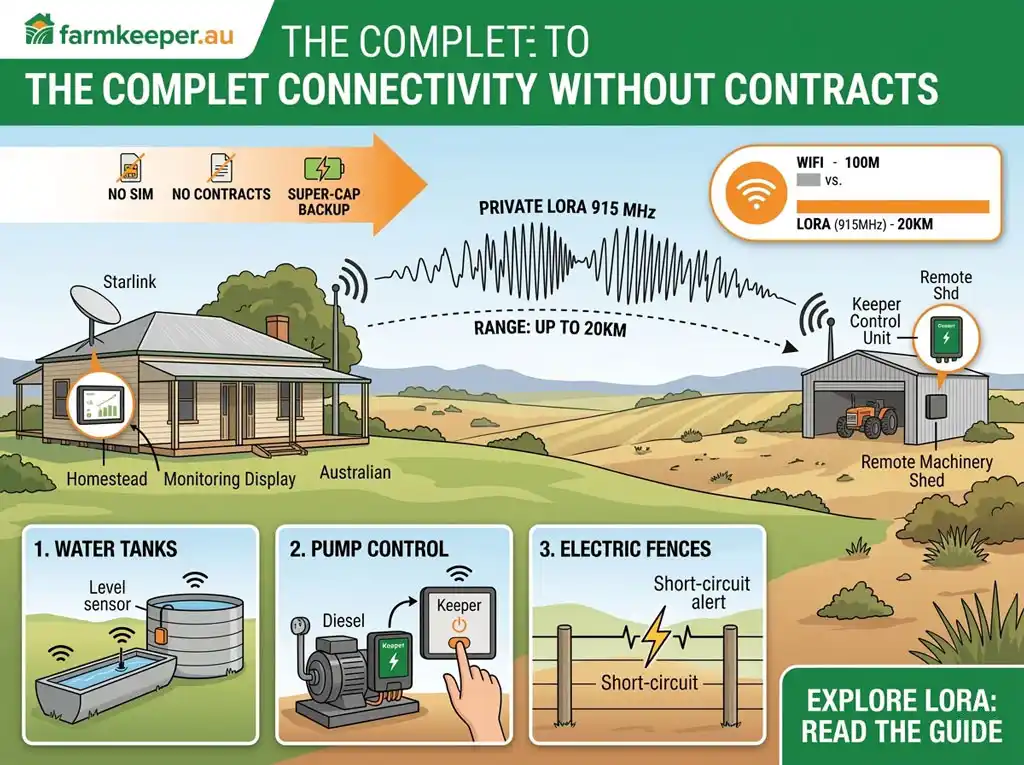
The Keeper v3.0 bypasses the need for a gateway or internet connection entirely. It uses a direct LoRa link on the 915 MHz band to connect a Control Unit (in the paddock) to a Monitoring Display (in the house). How it utilises LoRa tech:
- 20km Range: By stripping away the overhead of the complex LoRaWAN network protocol and using a focused P2P protocol, it achieves ranges of up to 20km line-of-sight. This covers the vast majority of Australian family farms.
- Supercapacitor Backup: One of the risks of remote monitoring is power failure (or thieves cutting power). The Keeper leverages LoRa's low power to run on a supercapacitor. If external power is cut, the capacitor has enough energy to fire off a "Power Loss" LoRa distress signal to the house before it dies. This wouldn't be possible with power-hungry WiFi or 4G.
- Two-Way Control: Most simple LoRaWAN sensors are "uplink only" (they send data). The Keeper uses P2P to allow downlink control. You can press a button on the display in your kitchen, and the LoRa signal triggers a relay on the unit 10km away—turning on a siren, a light, or a pump.
The "Hybrid" Use Case:
Many innovative farmers are now using a mix. They use standard LoRaWAN sensors for soil moisture (where data trends matter), but a dedicated P2P system like Keeper for critical security and control (where reliability and speed matter). You don't want your "Gate Open" alarm delayed because the cloud server is doing a firmware update. You want the buzzer on your desk to go off now.
Conclusion: The Connectivity Revolution
For too long, Australian farmers have been told that "Smart Farming" requires full 4G coverage or expensive subscriptions. LoRa technology has proven that lies are false. By utilising the physics of the 915 MHz band, farmers can now own their own network. They can monitor the un-monitorable. They can secure the back blocks. And they can do it with hardware that costs less than a single tank of diesel.
Whether you choose to build a complex LoRaWAN data network for agronomy or deploy rugged P2P tools like the Keeper v3.0 for infrastructure monitoring, the outcome is the same: Peace of Mind. In 2025, you won't need to drive 20km to check a tank. You need to listen to the Chirp.
Glossary of Terms for Farmers
- Gateway: The "Router" for LoRaWAN. Speaks LoRa to sensors, and 4G/Internet to the cloud.
- Node: The sensor or device in the paddock.
- P2P (Point-to-Point): Direct communication between two LoRa devices without a gateway.
- Line-of-Sight: A straight, unobstructed visual path between antennas.
- Noise Floor: Background radio static. LoRa works well even when the "noise floor" is high.
- AU915: The legal frequency band for LoRa in Australia (915-928 MHz).