
Control Livestock, Yards and Electric Fence Functionality | FarmKeeper.au
Keep your stock secure, track vehicle movements, and verify your fences are pulsing—all without leaving the homestead.
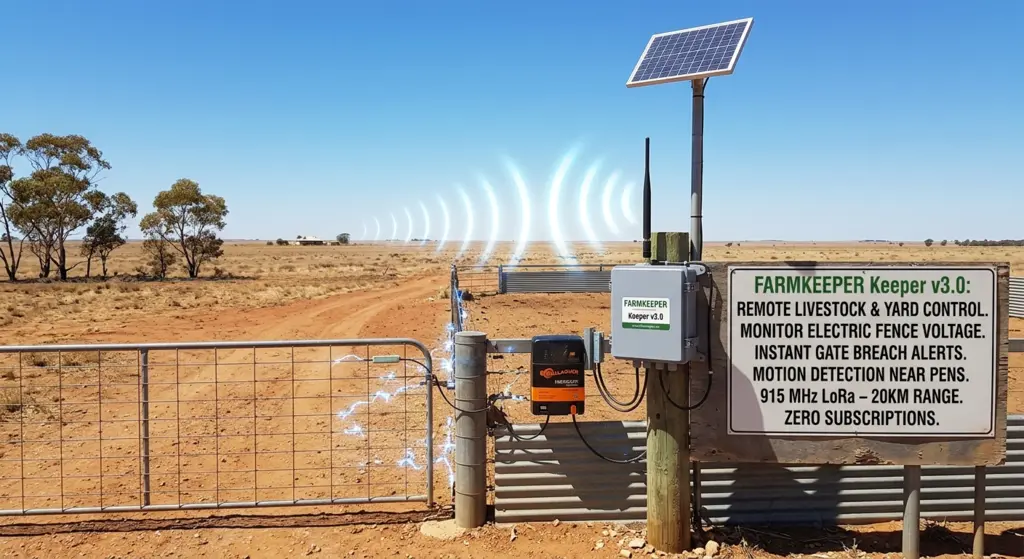
It’s dusk. You’re back at the house, boots off, but your mind is out in the back paddock. Are the weaners pushing the boundary fence? Did the contractor remember to latch the loading ramp gate? In Australia, managing vast distances means you constantly battle the unknown. If you want to successfully control livestock and protect your valuable assets, you need to know exactly what is happening out in the paddocks in real-time.
The Daily Struggle: The "Fence Run"
Electric fencing is the backbone of modern grazing management. It keeps predators out and keeps your feed budgets intact. However, an electric fence is only as good as its current voltage. A fallen red gum branch, a kangaroo strike, or heavy weed growth can short out a line in seconds.
If the voltage drops, cattle and sheep will figure it out incredibly quickly. They push through, resulting in mixed mobs, ruined pastures, or worse—stock wandering onto public roads. Traditionally, ensuring proper electric fence functionality meant doing the dreaded "fence run"—driving kilometres of boundary track with a fault finder just to verify the energiser is doing its job. It eats up your day, your diesel, and your patience.
Securing High-Value Targets: Pens and Yards
Holding yards, shearing sheds, and loading ramps are critical infrastructure, but they are often highly isolated from the main homestead. This isolation creates two distinct problems:
- Stock Theft: Rural crime remains a massive issue. Thieves target remote pens because they have hours to back a truck up to a loading ramp and disappear. Monitoring activities near pens and yards is no longer just a luxury; it is a necessity for boundary security.
- Human Error: Often, the biggest threat isn't malicious. A truck driver, a shearer, or a farmhand might accidentally leave a critical gate unlatched. Without a way to verify the gate status, a simple mistake can lead to hundreds of sheep boxing together overnight.
The Communications Black Hole
The obvious answer is to monitor these areas remotely, but standard AgTech often fails in the bush. 4G/5G cameras and sensors rely entirely on mobile phone networks. If your holding pens are 15 kilometres away in a cellular dead zone, these gadgets are useless. Furthermore, farmers are exhausted by "subscription fatigue"—paying monthly fees to software companies just to check if their own gate is closed.
To truly solve this, you need a system that bypasses the telcos entirely. This is where LoRa (Long Range) technology on the license-free 915 MHz band becomes your best farmhand.
Enter Keeper v3.0: Off-Grid Livestock and Fence Control
The FarmKeeper Keeper v3.0 is engineered specifically for these harsh Australian realities. Operating completely off-grid with zero subscription fees, it can transmit critical alerts over a massive 20-kilometre range straight to a Monitoring Display in your kitchen. Here is how it changes the game for livestock management:
- Monitor Electric Fence Functionality: You can wire a standard fence-fault relay (which outputs a dry contact when fence voltage drops below a safe threshold) directly into the Keeper's Door Sensor Input (Terminal 8). If a roo takes down your hot wire, the Keeper instantly sends a "Fault" alert to your home display. You only drive the fence line when you actually need to fix a problem.
- Track Activities Near Pens and Yards: The Keeper v3.0 features a built-in PIR (Passive Infrared) motion sensor. Mount the unit facing the approach to your loading ramp. If a vehicle or person moves near the pens after dark, you will get an immediate motion alert.
- Gate Security Verification: Install a heavy-duty magnetic reed switch on your main yard gates. If the gate is left swinging open by a contractor, the Keeper will alert you instantly, allowing you to fix the issue before the stock get out.
- Built for the Outback: The unit runs effortlessly off a small 6-30V DC solar setup. Even better, it relies on an internal supercapacitor instead of a lithium battery, meaning it won't swell or catch fire in the blistering 45°C summer heat.
How to Setup Your Yard & Fence Monitor
Deploying the Keeper v3.0 to manage your livestock infrastructure is straightforward:
- Power Up: Connect your local solar battery (12V or 24V) to Terminals 1 & 2 on the Keeper Control Unit.
- Wire the Fence Relay: Connect the dry-contact output from your electric fence fault monitor to Terminal 8 and Terminal 9 (Ground). Set the unit to the appropriate mode so that a closed circuit means "Fence OK" and an open circuit means "Alarm".
- Wire the Yard Gate: If you are monitoring a gate instead of the fence, connect your magnetic reed switch to the same Terminals (8 and 9).
- Position for Motion: Ensure the built-in PIR sensor (Component 13) has a clear line-of-sight to the driveway or loading ramp to detect incoming activity.
- Install a Local Siren (Optional): Wire a 12V siren to Terminal 3 (Output 1). If rustlers approach the pens, you can use your home display to remotely trigger the siren and scare them off before they even drop the tailgate.
Stop wasting fuel chasing fence shorts and stop lying awake worrying about your isolated yards. By establishing your own subscription-free radio network, you can take total control of your livestock management and protect your livelihood from the comfort of the homestead.
Ready to lock down your livestock infrastructure?
Dive into the technical documentation to see exactly how it wires up, or reach out to our team to discuss your specific property layout.