Control Farm Irrigation, Pumps and Watering Systems: Switch pumps and valves remotely | FarmKeeper.au
Take back your time, fuel, and sanity by automating the hard yards.
It’s 2 AM. The ute’s headlights are bouncing across a corrugated dirt track, and you’re driving 15 kilometres just to hit a start button on a river pump. When you manage farm irrigation, time, fuel, and sleep are routinely sacrificed to the tyranny of distance. It doesn't have to be this way.
The Hidden Cost of Farm Irrigation
In Australia, distance is the enemy. Getting water to where it needs to be—whether it’s a turkey nest dam, an extensive pivot irrigation setup, or a distant stock trough—requires pumps and valves. Traditionally, managing these assets means physical labour. You drive out to open a valve, drive back. You drive out to start the diesel or solar pump, and drive back to turn it off.
The wear and tear on your vehicles, the cost of diesel, and the hours of lost productivity add up incredibly fast. The obvious answer is to modernise your setup so you can control and switch pumps and valves remotely. However, taking that step often introduces a brand-new set of headaches.
The Problem with "Smart" AgTech in the Bush
The AgTech boom promised to put the entire farm on our smartphones. But there’s a catch: most of these systems are entirely dependent on mobile phone coverage. If your pump shed is in a cellular black spot, or if the 4G tower goes down during a summer storm, your "smart" irrigation system suddenly becomes useless.
Furthermore, these cloud-based systems come with an endless cycle of "subscription fatigue." You are forced to pay monthly fees for SIM cards, app access, and server hosting just to turn on a water pump you already own.
Radio Waves Over Phone Towers: The Technical Solution
To reliably control farm irrigation without relying on the phone networks, we need to bypass cellular infrastructure entirely. This is where LoRa (Long Range) technology on the license-free 915 MHz ISM band changes the game.
Think of radio frequencies like light. High frequencies (like your home WiFi or 5G mobile network) carry a lot of data but are easily blocked by walls, hills, and heavy foliage. Lower frequencies, like 915 MHz, operate more like a deep bass note. They can punch through timber, scrub, and undulating terrain over vast distances.
By using LoRa technology, we can send small, reliable data packets—like a simple "Turn Pump ON" command—across the paddock directly from a controller to a receiver, without the internet getting in the middle.
Enter Keeper v3.0: Control and switch pumps and valves remotely
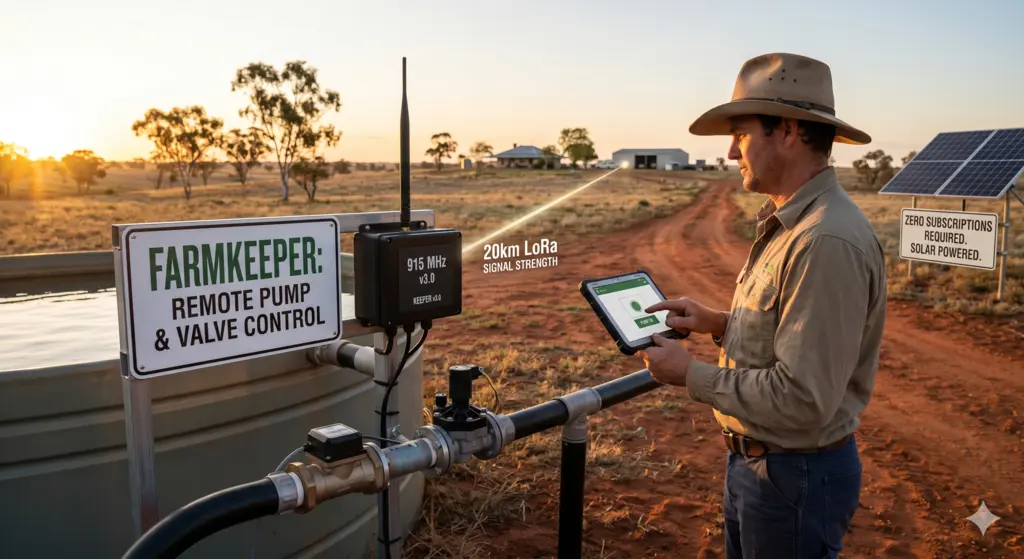
The FarmKeeper Keeper v3.0 was engineered precisely for this reality. It is an off-grid, autonomous communication system designed to thrive in the harsh Australian outback. Here is how it solves the remote irrigation problem:
- Massive 20 km Range: Operating on the 915 MHz LoRa band, the Keeper v3.0 can transmit commands up to 20 kilometres line-of-sight. With a high-gain external antenna, you can control a pump station from the other side of the property without needing a single bar of mobile service.
- Zero Subscriptions: You own the hardware and you own the radio network. There are no SIM cards, no monthly fees, and no cloud servers to crash. Once it's installed, the ongoing cost is zero.
- Off-Grid Power Ready: The Keeper v3.0 Control Unit accepts a wide DC input range from 6V up to 30V. This means you can power it directly from the 12V or 24V solar setup already running your water pump. It only draws an incredibly low 7 mA while monitoring.
- Heavy-Duty Switching: The unit features two External Device Outputs. These are low-side switches capable of handling up to 30V and a massive 50A starting inrush current. This means you can wire it directly to a heavy-duty pump relay or solenoid valve. When you push the button on your Monitoring Display back at the homestead, the Keeper receives the signal and instantly engages the pump.
How to Setup Your Remote Switch
Wiring the Keeper v3.0 to manage your farm irrigation is straightforward:
- Power the Unit: Connect your solar battery to Terminals 1 (+) and 2 (-).
- Wire the Relay: Connect the negative wire of your pump’s starter relay (or solenoid valve) to Terminal 3 (Output 1), and wire the positive side to your power supply.
- Verification (Optional but Recommended): Connect a pressure switch or flow switch on the pipe to Terminal 8 (Door Sensor Input). This acts as a feedback loop. You send the command to start the pump, and the pressure switch immediately sends a signal back to your display confirming that water is actually flowing.
Stop burning daylight and diesel. By implementing a dedicated, subscription-free radio link, you can modernise your farm irrigation and ensure that you can reliably control and switch pumps and valves remotely, no matter how far off the grid you are.
Ready to automate your water infrastructure?
Dive into the technical details to see exactly how it wires up, or reach out to our team to discuss your specific property layout.