
30 Minutes
Easy (Basic wiring skills)
Screwdriver, wire strippers, 12V battery or solar setup.
In the bush, your machinery shed is your livelihood. It’s where the tractor, the quad, and the tools live. But because it’s often kilometres from the house, it’s also a sitting duck for thieves. The traditional solution? Expensive satellite alarms or cellular cameras that stop working the moment the thief cuts the power or the 4G signal drops out.
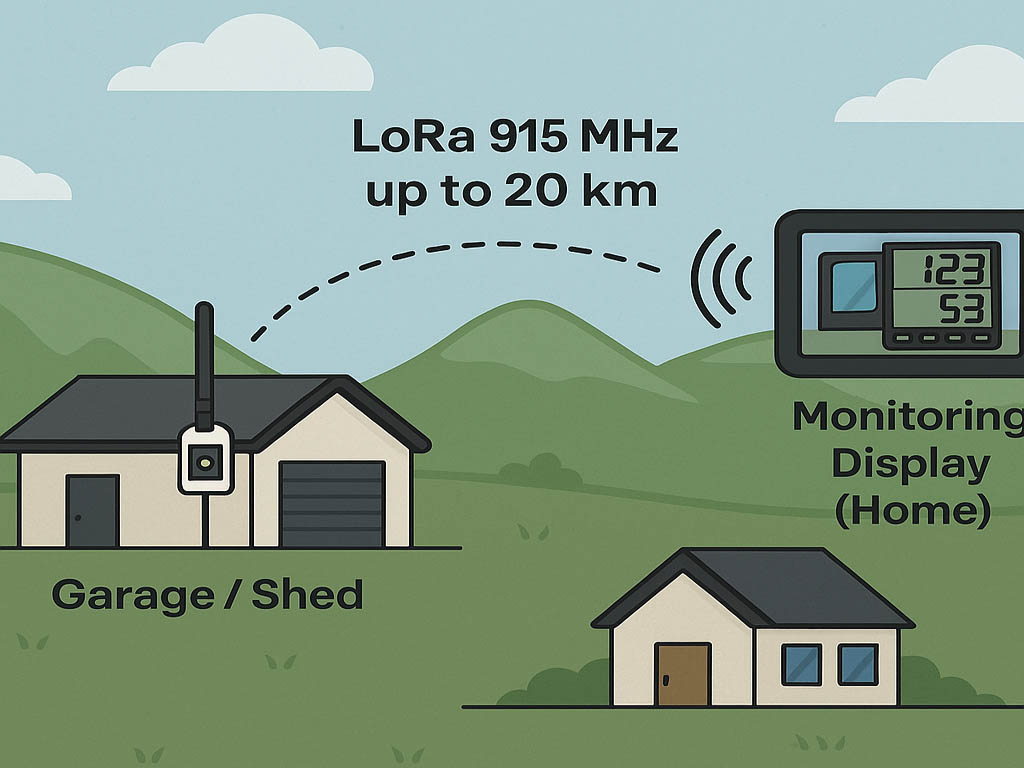
Today, we’re going to show you how to lock down that shed using the Keeper v3.0. It uses a long-range LoRa radio (no SIM cards) and has a built-in supercapacitor backup. Best of all, you can install it yourself before your morning smoko is over. Follow this clear 30-minute installation guide to quickly set up your security system and start protecting your shed today.
First, grab your gear. The Keeper v3.0 kit includes the Control Unit (for the shed) and the Monitoring Display (for the house). You will need a power source. The Keeper is incredibly flexible—it accepts anything from 6V to 30V DC.
The Goal: We will set up the unit in Mode 1, known as the 'Fort Knox' setting. It activates the Door Sensor, Water Sensor (optional), and PIR Motion Sensor simultaneously for maximum security.
Find a spot inside the shed to mount the Control Unit.
Wiring the Power:
As soon as you connect power, the unit will wake up. You’ll hear one long beep followed by a series of short beeps. Count the short beeps—if you hear one short beep, you are already in Mode 1. If not, don't worry, we’ll fix that in a second.
Now we connect the sensors that will catch the intruder.
Mount the magnetic switch on the shed door frame and the magnet on the door itself. Run the wires back to the Keeper unit.
How it works: When the door opens, the circuit breaks, and the alarm triggers immediately.
Good news—you don't need to wire this. The Keeper v3.0 has a built-in PIR sensor (Component 13) right on the board.
Tip: Ensure the front of the unit has a clear line of sight to the area you want to watch (e.g., the space in front of the tool chest). The sensor detects movement up to 5 metres away.
Want to scare them off? You can wire a loud 12V siren to the unit.
The Keeper acts as a switch. When the alarm goes off, it grounds Terminal 3, completing the circuit and blasting the siren. It can handle high-current devices up to 50 Amps, so don't be shy with the size of the siren.
Setting the Mode: If the unit wasn't in Mode 1 when you powered it up:
Mode 1 monitors Door, Water, and Motion simultaneously.
The Handshake: Go back to the house and plug in the Monitoring Display via USB. Extend the antenna. Walk back to the shed and trigger the alarm (open the door or wave your hand). The Display at the house will beep, and the screen will show the new unit active. It’s now paired.
The Final "Cut" Test: Here is the coolest part. While the system is armed, disconnect the battery wire at the shed (as if a thief cut the power). Thanks to the internal supercapacitor (Component 17), the unit won't die instantly. It will stay alive for a few minutes—plenty of time to send a "Power Loss" alert to your display. You’ll know they are there, even if they think they’ve disabled the system.
Walk away and let it do its job. For the first hour, the LED on the unit will flash to show you it's working. After one hour, it enters "Stealth Mode"—the lights turn off and it goes silent. It looks like a dead plastic box, but it’s listening for the slightest movement.
Sleep easy tonight. The Keeper is on watch.