
Stopping Catastrophic Poly Tank Splits: Automated Supply Pump Cutoffs
Disaster Mitigation for Remote Water Storage & Solar Bore Infrastructure
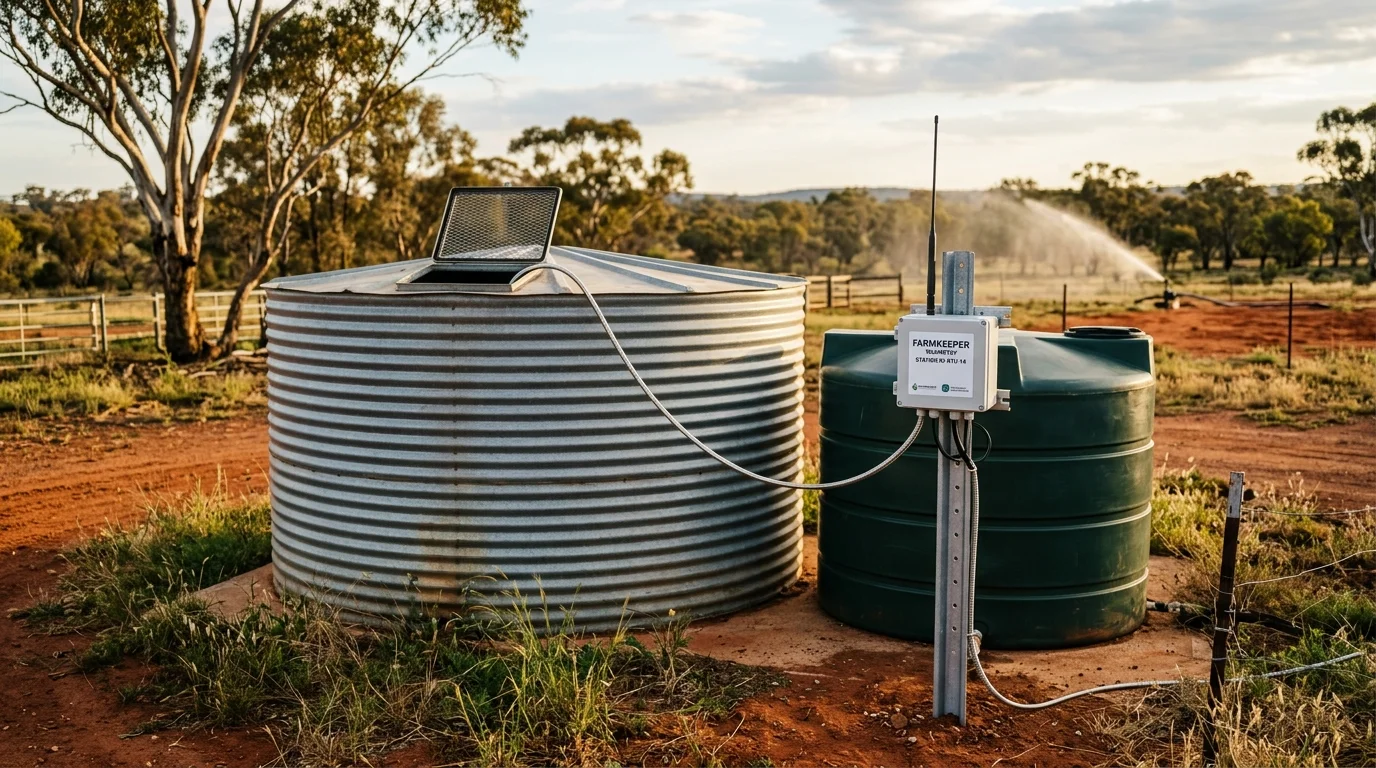
The Outback Scenario: When a 25,000L or 50,000L polyethylene storage tank suffers a vertical hoop-stress split or a sheared base outlet fitting, gravity empties tens of thousands of litres of clean water in under 90 minutes. But the real financial catastrophe begins right after: traditional automated float systems register an "empty tank" and immediately crank your solar bore or transfer pump, pumping hundreds of thousands of litres directly into the mud for days on end. Here is how to stop it automatically using subscription-free Farmkeeper point-to-point radio telemetry.
1. The Anatomy of a Poly Tank Failure in Rural Australia
Polyethylene (poly) water tanks are the backbone of Australian pastoral water reticulation. They are durable, easy to transport, and resistant to corrosive bore minerals. However, after 8 to 15 years under brutal Australian UV radiation, thermal expansion cycles from 45°C summer days to sub-zero winter dawns, and relentless ground shifting, poly tanks become brittle.
Catastrophic failure typically occurs in three distinct ways:
- Hoop-Stress Seam Splits: Hydrostatic pressure creates maximum radial tension around the lower third of the tank wall. A tiny hairline UV stress crack can instantly unzip into a 2-metre vertical tear, releasing 25,000 litres in a roaring tidal wave.
- Sheared Base Flange Outlets: Rigid 2-inch or 3-inch PVC or metric poly discharge pipes connected directly to bottom brass tank outlets without flexible expansion loops. When the tank settles into its sand pad or cattle bump the pipe, the outlet fitting snaps flush with the tank wall.
- Fereral Animal Damage: Feral pigs, kangaroos, or agitated bulls scratching against bottom ball valves, snapping poly manifolds off at ground level.
2. The "Double Disaster": Why Standard Float Switches Make It Worse
Most remote stock water setups utilize a simple mechanical float switch or top-mounted ballcock valve. If the water drops below 50%, the switch closes a contact to start the solar bore pump or river transfer pump. When full, it opens to stop.
Here lies the fatal flaw:
A conventional float switch only understands level—it has zero understanding of rate of change.
When a tank splits open, the float hits the bottom of the tank within minutes. The controller assumes your cattle simply had a big drinking afternoon and engages the 7.5kW submersible bore pump. Because the tank has a massive hole in its side, water never accumulates. The pump runs continuously at maximum duty cycle:
- Aquifer Depletion: Thousands of litres of precious subterranean groundwater are pumped onto waterlogged soil, forming a useless bog.
- Motor Burnout: The bore pump runs dry once the dynamic water table drops, cavitating in abrasive sand and melting diffusers ($6,000 to $10,000 replacement cost).
- Downstream Herd Dehydration: Because pressure cannot build in the spine line, distant paddock troughs go bone dry, leaving stock without water 15 km away.
3. The Technical Solution: Rate-of-Change (ΔLevel / Δt) Telemetry
To prevent this double disaster, water monitoring systems must evaluate the speed at which water is leaving the vessel.
The Farmkeeper Keeper v3.0 system continuously samples hydrostatic water head using a stainless steel submersible pressure transducer suspended inside the tank. The internal firmware tracks the differential rate of level change:
Normal Cattle Demand vs. Catastrophic Rupture Threshold
- Normal Peak Grazing Demand: 150 head of adult steers drinking simultaneously from linked troughs draw roughly 1,500L to 2,500L per hour (a level drop of ~1% to 2% per 15 minutes on a 25,000L tank).
- Catastrophic Rupture Event: A split wall or sheared 2-inch outlet empties at 12,000L to 20,000L per hour (a level drop exceeding 10% in under 15 minutes).
When the Farmkeeper node calculates that the drawdown gradient exceeds the calibrated safety limit, it immediately flags a Rupture Event rather than a standard low-water refill call. It locks out the local transfer output and transmits a high-priority emergency sub-GHz kill packet to the bore pump station.
4. Autonomous 20 km Radio Link: Zero Cellular or Cloud Delay
Many smart farm systems rely on 4G cellular SIM cards or satellite relays. If your tank sits in a creek hollow without mobile reception, or the telco tower suffers an outback power outage, cloud-based alerts fail to deliver.
Farmkeeper bypasses all third-party networks entirely. Operating on the license-free 915 MHz ISM band with high receiver sensitivity, Farmkeeper field nodes communicate point-to-point over up to 20 kilometres line-of-sight. The emergency shutoff packet travels from the tank directly to the solar bore controller in under 800 milliseconds.
Simultaneously, the packet reaches the Homestead Desktop Console on your kitchen table, sounding a piercing audible alarm and displaying:
LEVEL: 42% -> 18% (RATE: -24%/15m)
SOLAR BORE PUMP 02 -> EMERGENCY CUTOFF ENGAGED
5. Terminal-by-Terminal Wiring Guide for the Keeper v3.0
Setting up emergency tank rupture cutoff on the Keeper v3.0 is straightforward and requires zero coding or laptop programming in the field.
| Terminal | Function | Field Connection & Purpose |
|---|---|---|
| Terminal 1 & 2 | Power Supply Input (6V to 30V DC) | Connect directly to a 12V AGM battery charged by a small 20W solar kit. Reverse-polarity protected. |
| Terminal 9 & 10 | Hydrostatic Transducer Loop | Terminal 9 (Common Ground) and Terminal 10 (Water Level Signal). Reads dynamic head pressure from the tank floor. |
| Terminal 3 | External Device Output 1 (50A MOSFET) | Low-side switch connected to an inline 12V latching isolation solenoid valve on the tank discharge line. Shuts gravity outlet immediately. |
| Terminal 4 | External Device Output 2 | Connects to a 12V flashing LED strobe beacon or siren mounted to the tank roof to alert station hands in nearby paddocks. |
| Terminal 12 | SMA RF Connector | Connects to a 915 MHz omnidirectional or Yagi directional antenna elevated on a 3m pipe mast to clear the tank rim. |
6. Why Point-to-Point Radio Beats Cellular Subscription Systems
Major corporate farm telemetry brands charge ongoing annual fees for every water tank monitor on your station. Over 5 years, subscription fees rapidly outstrip the initial purchase price of the hardware.
| Feature | Corporate Cellular SIM Systems | Farmkeeper Keeper v3.0 |
|---|---|---|
| Ongoing Monthly Fees | $300 to $600 / year per tank | $0.00 Forever (No Subscriptions) |
| Mobile Blackspot Operation | Fails without 3G/4G coverage | 100% Functional (915 MHz Direct) |
| Autonomous Pump Cutoff | Requires cloud relay & internet link | Direct Node-to-Pump Radio Interlock |
| Outback Heat Resistance | Lithium batteries swell in +50°C heat | Supercapacitors rated up to +70°C |
7. Practical Installation Tips for Australian Graziers
- Install Flexible Bellows on Base Outlets: Never plumb rigid PVC directly into a poly tank fitting. Install a 300mm reinforced flexible rubber bellows or braided stainless expansion coupling between the tank outlet flange and the ground manifold. This absorbs tank expansion and cattle nudges.
- Anchor Submersible Sensors in Stilling Wells: Never drop a bare hydrostatic transducer directly into a tank where swirling inflow water can toss it against the walls. Slide the sensor inside a perforated 50mm PVC conduit pipe anchored vertically to the tank wall.
- Elevate Your Antenna Above the Tank Roof: A full 25,000L poly tank acts like a giant solid cylinder of water that absorbs 915 MHz radio waves. Always mount your antenna on a galvanised bracket extending at least 1 metre above the highest point of the tank roofline.
Protect Your Station's Water Assets Today
A single poly tank rupture can cost over $8,000 in lost water, damaged pumps, and dehydrated stock. The Keeper v3.0 Starter Package equips your property with complete 20 km autonomous tank telemetry, pump control relays, and an indoor homestead console with zero recurring fees.