LoRa as the Real Foundation to Organize a Smart Farm
Controlling Sensors Across the Paddock Without Mobile Coverage
For Australian farmers, the concept of the "Smart Farm" has often felt like an empty promise. The technology industry constantly pushes the idea of interconnected sensors, automated water pumps, and remote gate alarms. However, there has always been one massive, glaring obstacle blocking this vision: connectivity. The harsh reality is that the vast majority of Australian farming land sits in cellular blackspots. 4G and 5G signals drop off entirely just a few kilometres from the nearest town, and traditional Wi-Fi networks are virtually useless the moment you step outside the immediate vicinity of the main homestead.
If you cannot reliably send a text message from your back paddock, how are you supposed to monitor a critical water trough or secure an isolated machinery shed? The answer does not lie in building more cellular towers or paying exorbitant fees for satellite internet. The true, practical foundation for agricultural automation is LoRa (Long Range) radio technology.
What is LoRa and Why Does it Matter?
LoRa stands for "Long Range" radio. It is a specialised wireless communication technology designed specifically to send small amounts of data over long distances using very little power. Unlike cellular networks, which require massive infrastructure and expensive monthly subscriptions to telecommunications companies, LoRa operates on free, publicly available radio frequencies. In Australia, this is the license-free 915 MHz ISM (Industrial, Scientific, and Medical) band.
By utilizing this specific Sub-GHz radio frequency, LoRa signals possess unique physical characteristics. They can easily penetrate through thick foliage, timber stands, and over undulating terrain that would instantly block higher-frequency Wi-Fi signals. This makes it the perfect communication medium for the vast, rugged environments typical of Australian agriculture.
Populating the Farm Ecosystem Without Mobile Networks
The beauty of a Point-to-Point (PtP) LoRa system is that it allows you to build your own private communication network across your property. You become completely independent of mobile phone providers. If a major storm takes out the local Telstra or Optus tower, your farm’s internal network remains completely unaffected. Your sensors will still talk to your displays, and your automatic pumps will still trigger when water levels drop.
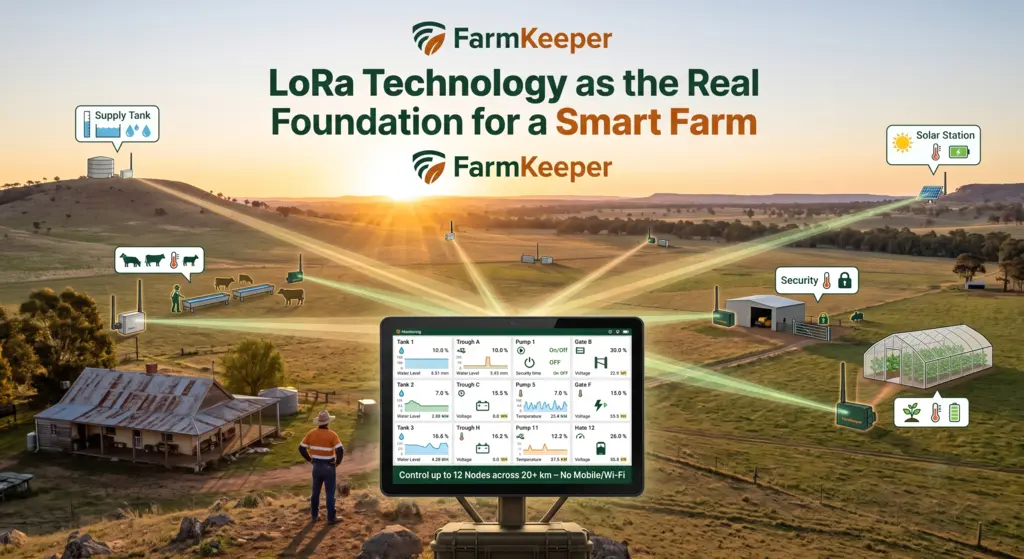
Imagine a typical large-scale farm. You might have a main water supply tank located 10 kilometres to the north, a series of livestock drinking troughs scattered across the western paddocks, and an equipment shed located near the main gate. Monitoring all of these assets traditionally required hours of driving, burning expensive diesel just to physically look at a float valve or check a padlock. With a LoRa-based system, you can attach digital sensors to all of these critical points. These sensors can monitor water levels, detect the opening of a gate, read the ambient temperature, or sense motion using built-in Passive Infrared (PIR) detectors.
The Power of Centralised Control: One Display, Twelve Devices
To make a Smart Farm truly functional, the data gathered by these distant sensors needs to be presented in a way that is easy to understand and manage. This is where advanced control architecture comes into play. The most efficient systems utilize a single, centralised hub to monitor multiple remote nodes.
The Multi-Node Advantage: Modern systems are designed for scale. One single portable monitoring display placed in the comfort of your farmhouse can track and manage up to 12 separate control units located out in the field. The display unit stores the individual settings and configuration for all 12 registered control units in its internal non-volatile memory, meaning it remembers every specific parameter even if the power is turned off.
This 1-to-12 architecture completely revolutionizes farm management. You do not need a messy collection of different screens, apps, or receiver boxes. Unit 1 can be configured to monitor the main tank's critical water level using a door-sensor input. Unit 2 can be configured with a 20-second delay on the water sensor input to monitor a busy livestock trough without triggering false alarms from splashing. Unit 3 can be set up in the tractor shed with its built-in PIR motion sensor active to detect intruders. All of this diverse data is beamed back across the 915 MHz band over distances of at least 20 kilometres in open areas, straight to the single display sitting on your kitchen counter.
When the trough water gets low at Unit 2, the control unit can automatically trigger its low-side switch output to power up a water pump, while simultaneously sending an alert to your central display. You maintain complete situational awareness and control over 12 distinct geographical locations without ever relying on a single bar of mobile phone service.
An Open Letter to Australian Farmers
We understand that adopting new technology on the farm can be daunting, especially when past solutions have over-promised and under-delivered. To address this, we have drafted the following open letter detailing exactly how our technology solves these persistent rural challenges.
To the Hardworking Farmers of Australia,
For too long, the AgTech industry has treated rural Australia as an afterthought. You have been sold expensive cellular monitors that drop out the second the weather turns, and you have been trapped in endless monthly subscription fees just to look at data generated on your own land.
It is time to take back control of your farm's infrastructure. We designed the Keeper v3.0 specifically to solve the connectivity crisis in the paddock. Operating on completely free, long-range LoRa radio waves, the Keeper v3.0 punches through 20 kilometres of open air to bring your farm’s vital signs directly into your living room—with absolutely zero ongoing data costs or SIM card fees.
The true power of this system is in its scale. We know you don't just have one water tank or one gate to watch. That is why a single Keeper v3.0 Monitoring Display can connect to and control up to 12 separate devices simultaneously. From one screen on your kitchen bench, you can monitor the trough in the north paddock, the security of the main machinery shed, the temperature of the greenhouse, and the critical water level of the main supply tank.
If the tank runs low, the Keeper v3.0 doesn't just warn you; it can automatically switch on the remote water pump for you. It does all of this safely, using heat-proof supercapacitors instead of dangerous lithium batteries, ensuring it survives the brutal Australian summer heat.
Stop driving endless kilometres just to check a float valve. Stop paying monthly subscriptions for spotty mobile coverage. Build your own private, reliable network today with the Keeper v3.0, and manage your entire property from the comfort of your home.
Work smarter, not harder.
— The Farmkeeper Team
The foundation of the modern smart farm is not built on mobile phone towers. It is built on reliable, subscription-free, long-range radio technology. By embracing LoRa point-to-point systems, Australian farmers can finally achieve the automation and peace of mind they deserve, regardless of how far off the grid they operate.
Ready to Connect Your Paddock Without Contracts?
Explore the Keeper v3.0 system specifications or order your off-grid telemetry starter kit today.
View Keeper v3.0 Details Contact Farmkeeper Team